"CHICAGO — A federal jury in Chicago has convicted a Silicon Valley businessman of defrauding investors in his computer companies after soliciting and obtaining some of the money via crowdfunding.
JEFFREY BATIO, 50, of Santa Clara, Calif., was found guilty Friday of all 12 counts against him, including six counts of mail fraud and six counts of wire fraud. Each count is punishable by a maximum sentence of 20 years in prison. U.S. District Judge Rebecca R. Pallmeyer set sentencing for Sept. 3, 2019."
How many of the crowd-funding projects are real, and how many are somewhere between fraud and someones wild dreams? Is this one an outright fraud?
I wrote something all too long for Google+, so I decided to hijack my Python blog for this...
Do you think
the Dagonfly Futurefön will actually be produced? It seems that 1739 investors thinks it will as of 2014-11-14, or are they deliberately throwing away those $362030...
Jeff Batio has tried to build something really ground-breaking for many years, but as far as I understand, there's been no payback from investments in his inventions. He has gathered a lot of money from investors though, and at least one state has taken him to court and banned his stock sales.
Note that Mr Batio decided go through with his project if he just got $10000. Could he really start production of revolutionary consumer electronics for $10000, or is he just very eager to cash in, regardless of whether the project has a chance to succeed or not?
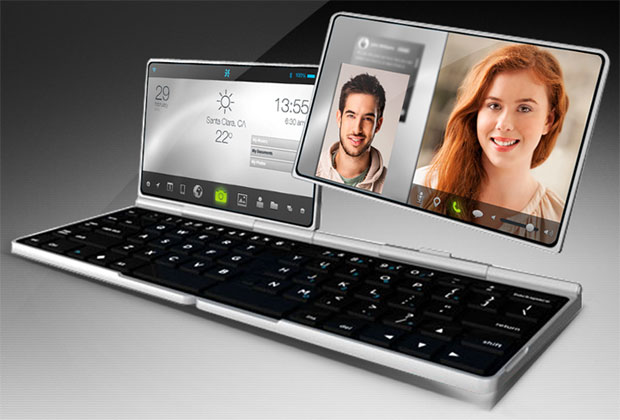
He promises something revolutionary: A very light Intel i7 laptop bundled with a smartphone/pad, the whole package weighing just one pound. This includes enough battery to run the i7 for 8.5 hours. This is less than half the weight of any current i7 laptop, and he'll also include the phone.
One IDG Connect writer, Dan Swinhoe, has published
a short interview about the venture. No Pulitzer Prize ambitions... Just ask some easy question and let Mr Batio create the article text with his answers. A few blogs have also reported without questioning whether this is for real.
My warning bells go off when I read about Jeff Batio and his "Idealfuture Dragonfly Futurefön" (sic). It's not just the name... It all smells fishy, and the more I put my nose in it, the worse the smell seems.
Look at the texts, the pictures and videos at
Indiegogo and
Idealfuture's home page. Does it look real?
I know. They are in the middle of inventing, and no-one claims that the product is in production. But if you create a game changer, something really new, you probably need some decent prototypes to convince yourself and your investors/customers that it's even possible to produce this.
Almost all detailed product pictures, and all product appearance in the videos, seem to be animations. There are some pictures of people with "the Futurefön", but is there anything to suggest that those are more than 3D printed blocks of plastic with some chrome framing?
The only visual details I find is in the collage near the bottom of the Indiegogo page, where Bridget Hogan from the video, Mr Batio's VP of Social Media, holds a mock-up with a shiny chrome look.
I took a close look at that picture. Note that the right screen should
- work like a normal, folding laptop screen,
- swivel around,
- detach as in the middle picture,
- not accidentally fall off the base during transportation.
Has anyone managed to do this before? I think this is a core R&D effort, the first thing to get right.
Why is Ms Hogan holding on to the phone part in the upper left and right pictures? Not quite working yet?
How will this mechanism work without anything protruding from the screen or the base? (There is something protruding a bit in some of the computer simulations, and it looks as if that thing would prevent the swiveling rotation...)
Will this magic joint survive a few years of handling, bumping around in a backpack? Do you need to put your Futurefön in a special, protective case they didn't mention yet?
What about the technical specs? It is to be 155.575 mm wide when folded, and weigh 452.175 grams. Considering that they are still vague about some features, such as exactly which processor to use, whether it should be waterproof, and what battery to use, it's surprising that that they have such impressive and precise measures.
The "Slingshot" is a complete 7" phone, and it's supposed to weigh only 145 grams. The lightest 7" pad I can find for real weighs 239 grams. (The lightest 6" phone I find weighs 160 grams.) Don't forget that the "Slingshot" also needs some sturdy structure for the swiveling hinge. Some extending pin maybe?
The rest of the weight is 307 grams. That's for a complete Intel i7 laptop with a tiny 7" screen, 4GB RAM, 256GB SSD and enough battery for 8.5 hours of use. It needs to be sturdy despite being so thin, narrow and light, with hinges in the middle of the keyboard.
The smallest current netbooks, with 8.9" screen, weigh 0.99 kg. More than twice what a complete "Futurefön" is supposed to weigh...
Compared to any other Intel i7 based laptop, it will be 40% of the weight, much more narrow, and still have strength and space for the folding, and dissipate all the generated heat. Who will provide the material to build this? Aliens?
Mr Batio first worked on the idea of a 2-way foldable laptop in his old company Xentex. It seems like something was actually built then, since
an article in engadget mentioned a prototype for sale on Ebay in 2008. The Xentex Flip-Pad press release was also mentioned in 2002 by
pcmag.com (joking about the 5.7kg laptop) and by
mobilemag.com.
It seems it never came to production though, and Mr Batio has
a whole web site dedicated to telling the story of how he was swindled by people in his own board and some investors. He makes it sound like these people got so crazy that they started to destroy a company they owned and worked for, which was just on the verge of financial success. I think such things are more likely to happen to a company close to collapse...
Between the old bankrupted Xentex and the current Idealfuture, Mr Batio called his venture Armada Systems LLC. One of his patents on "Portable computer for dual, rotatable screens" was filed with Armada as owner. As recently as 2014-01-29, the State of Illinois,
noted that Mr Batio had between 2006 and 2010 sold "memberships" in Armada to approximately 75 people, for a sum of approximately $500 000. The state also noted that he had done this without registering as demanded by the law. He was then forbidden to sell shares in the state of Illinois... Oh dear!
Mr Batio has 500+ connections in
LinkedIn. The odd thing is that only 14 people of the 500+ have endorsed any of his skills. Have you ever seen such a LinkedIn profile? I didn't think that was possible. (Not that it ever happened to me that people endorsed skills they don't personally know I have. ;-)
By the way, one of his 14 endorsers is a 3D and VFX artist in Moscow. I can guess their connection... Another does music for advertising, and a third is a technical writer and engineer, who shoots, produces and directs film (some technical stuff I guess). The dream team...
Where are the real techies actually creating all the pieces in this puzzle? Even if you work with a lot of outsourcing, there is a lot of work to get a product to happen... Searching for Idealfuture at LinkedIn, you only get two hits: Mr Batio and Ms Hogan.
The only inside clue from Idealfuture among the pictures is one where they show their prototype workshop. Here you can see Mr Batio's first wooden mock-up of a fold-able laptop. Then there is one of the Flip-Pad prototypes, and various junk. Something might be a scaled up part of a keyboard hinge, and there is a couple of big, old motherboards. In the center, maybe the most important part: The product photography studio.
I suspect that they don't build the next generation of computing devices there. I think they build dreams...
I like Jeff Batio. He's like the inventor dad in Gremlins. I guess he believes in his overly complicated gadgets that have everything, and thinks that he can overcome all the technical hurdles. I mean, it's one item which is both a laptop and a phone and a presentation device (well if the guy you present to sits really, really close) and there is a pen in a little hole, and a Bluetooth headset behind a little hatch, and it folds so cleverly... Just like the Peltzer Bathroom Buddy! I almost expect a button for shaving foam.
Still, he ought to understand that his investors are likely to loose their money, just as I guess his previous investors did...
P.S. I just found something more: A year ago,
Mr Batio did the same thing! (Well almost, no videos and no Ms Hogan.) The "if convertible by idealfuture" which looks suspiciously like the Dragonfly Futurefön, collected $17945, in a campaign ending in December 2013. It was an inspiring first attempt I guess. Maybe it gave him the funding to produce the next campaign. It's not apparent to me that it lead to any production of hardware. I see no actual fold-ables for sale on ebay for instance. But there is someone who
tries to sell the one he didn't get yet...